


SICRC
Program Introduction
Program Introduction|
Fostering Synergy in Smart-Image Content Visual Arts and Technologies Research
-
Smart-Image Content Visual-Arts Team
Conducts research in smart-image content production, high-definition video planning, digital special-effects development, and smart gaming technologies -
AICFT(Advanced Imaging Cross Functional Team)
Engages in research on video processing and restoration, AR/VR, smart interaction, artificial intelligence (AI), and immersive graphics -
Advanced Imaging Cross-Functional Team (AICFT)
Conducts interdisciplinary research at the intersection of art and engineering, focusing on the planning, development, production, and dissemination of advanced, future-oriented, and smart-image content
The Global Humanities and Social Sciences Convergence Research Program
Affective AI-Based Storytelling and Image Generation for Global Cultural Content
Since 2025, our institute has been selected for the Global Humanities and Social Sciences Convergence Research Support Program (2025–2031), funded by the National Research Foundation of Korea (NRF).
This initiative aims to establish a new paradigm of emotion-centered creation by integrating human emotions and cultural contexts with artificial intelligence, moving beyond conventional data-driven approaches.
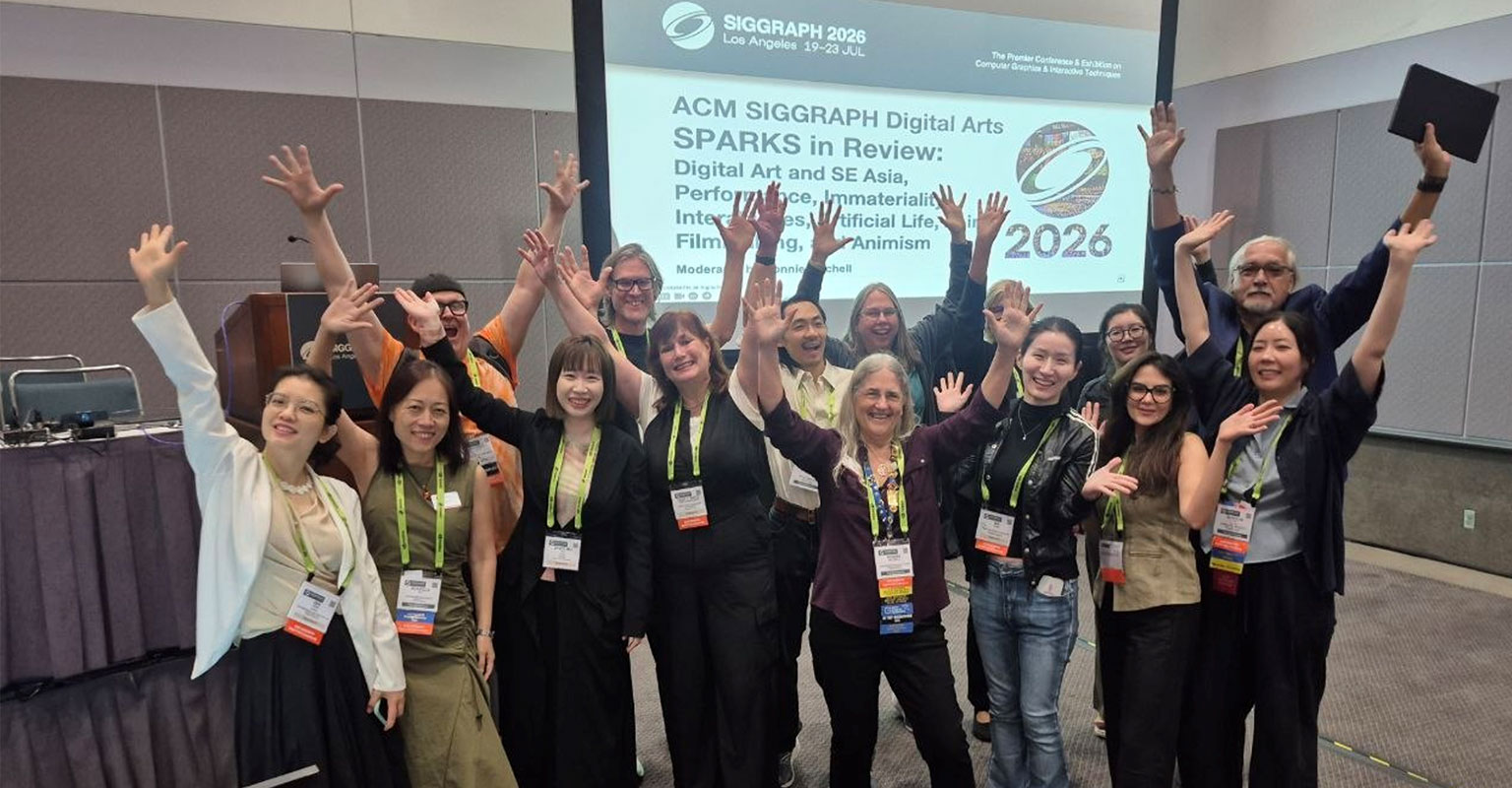
Through close international collaboration with the UCLA Art|Sci Center, we investigate cultural and emotional differences between Eastern and Western societies. Our goal is to develop emotional AI-based storytelling and audiovisual content generation technologies that resonate with global audiences.
-
Emotional AI Multimodal Generation Technology
We are developing a multimodal emotional AI system by constructing a mapping framework that connects emotional keywords, meanings, and affective states. This system enables cross-modal transformation and generation across text, images, and sound. -
Real-time Emotional Feedback Interaction
We design interactive content generation environments that dynamically reflect users’ emotional feedback in real time, enabling more immersive and adaptive experiences. -
Non-linear and Decentralized Storytelling
We explore differences in memory structures and emotional expression across cultures, and experimentally implement non-linear and decentralized storytelling models based on these insights. -
Global Cultural Receptivity Analysis
We conduct both qualitative and quantitative analyses of audience reception and interpretation of AI-generated audiovisual content, aiming to identify global emotional patterns and cultural variations.
Program Overview
Creative Smart-Image Content Production and Convergence Research in Visual Technologies
- Creating smart-image content that fuses creative artistic sensibility with cutting-edge technologies
- Conducting research on image technologies for use in film, animation, and interactive art, including AR, VR, 3D Video, UHD, and 360-degree imaging
- Exploring smart-image content technologies that personalize user experiences on smart devices by adapting to behavior and usage history
Fostering Global Academic Collaboration and Engagement
- Organizing academic conferences in the Institute of Electrical and Electronics Engineers (IEEE) signal-processing field
- Engaging in academic exchanges and joint research with Chiang Mai University (Thailand), Qingdao University of Science and Technology (China), the School of Visual Arts (USA), and the University of Florence (Italy)
- Conducting joint workshops with international institutions such as the Institut Français de Corée and École nationale supérieure d'architecture de Paris-La Villette (ENSA-PLV)
- Supporting international research by assisting with applications for international film festival residency programs
- Hosting the TechArt International Conference (first half of the year) and the Advanced Imaging International Festival (AIIF) International Conference (second half of the year) annually
Publication of International Scholarly Journal (Aiming for SCOPUS Indexing)
- TechArt: Journal of Arts and Imaging Science
- Editorial board comprising distinguished domestic and international scholars; published online three times a year
- Establishment of website and digital system for online submission, peer review, and publication
- Targeting SCOPUS indexing by 2027
- www.techart.cau.ac.kr
Publication of International Scholarly Journal (Aiming for SCOPUS Indexing)
- MINT: Moving Image & Technology
- An advisory board comprising renowned scholars from Korea and abroad, with the journal published online three times a year
- Development of a digital platform for online submission, peer review, and publication
- Aiming for inclusion in DOAJ by 2027
- www.mintjournal.cau.ac.kr
Building an Industry-Academia Network and Advancing Joint Research
- Establishing a dynamic and collaborative industry-academia network through diverse research initiatives; facilitating the exchange of human resources, technology, and materials with industry partners
- Pursuing joint research with specialized smart-image content institutions such as the Electronics and Telecommunications Research Institute (ETRI) and the Korea Electronics Technology Institute (KETI)
- Collaborating with content-related organizations, including the Korean Film Council (KOFIC) and Korea Creative Content Agency (KOCCA)
- Developing and operating a comprehensive production ecosystem and core hubs that span technology development, production, distribution, and exhibition
Driving Research-Project Acquisition and Implementation
- Supporting the implementation of research initiatives under the BK21FOUR project at the Graduate School of Advanced Imaging Science, Multimedia & Film, at Chung-Ang University
- Assisting the school in securing follow-up funding and projects as part of the BK21FOUR initiative
- Facilitating industry-academia-research collaboration as well as academic exchanges, educational partnerships, training programs, and internships related to ongoing research
- Identifying and acquiring government and industry-sponsored research opportunities in the field of smart-image content
- Organizing research teams capable of leading large-scale projects in convergent smart-image content and promoting the development of innovative research agendas
Program Objectives
Creative Smart-Image Content Production and Convergence Research in Visual Technologies
- Engaging in content production, technical education, and knowledge transfer across film, animation, and interactive art
- Pursuing creative content development and technological research that integrates film, animation, games, and cutting-edge visual technologies
- Conducting research on advanced imaging technologies—including AR, VR, 3D images, and 360-degree omnidirectional imaging—for application in film, animation, and interactive media
- Exploring smart-image content visual technologies that intelligently adapt and deliver content based on user behavior and past usage patterns on smart devices
Serving as a Global Hub for Convergent Research in Smart-Image Content
- Supporting an integrated research system that plans, develops, produces, and industrializes digital smart-image content to systematically promote K-Culture on a global scale
- Developing and implementing joint research programs with prestigious international universities
- Publishing and operating TechArt, an international English-language journal, with the goal of SCOPUS indexing
Building an Industry-Academia-Research Network for Smart-Image Content Research & Production
- Conducting project-based research focused on practical applications in industrial content production, supporting both core technologies and production techniques
- Establishing and managing a technological innovation network that connects domestic and international academic, industry, and research institutions. This network is designed to invigorate the digital-content industry—a key sector of the future—by encompassing the entire pipeline from development and production to distribution, exhibition, and business operations
Accumulation of Research Achievements under BK21PLUS and Promotion of BK21FOUR Initiatives
- Building on the accomplishments of the BK21PLUS “Global Creative Content Specialist Training Program”
- Supporting research activities and promoting international collaboration within the BK21FOUR “AI-Content Future Industry Education and Research Group”
- Advancing research outcomes through creative content production and interdisciplinary convergence
Program Plans
Creative Smart-Image Content Production and Research
- Creative Content Production: Leveraging its accumulated international recognition, the program aims to produce innovative film and animation content for submission to major festivals such as the Cannes Film Festival and Annecy International Animation Film Festival
- Advanced Content Creation: Producing content that integrates art and engineering, utilizing technologies such as AR, VR, 3D imaging, and 360-degree omnidirectional cinema
- Smart-Image Content Technologies: Conducting research in core areas of intelligent content—including planning, production, distribution, and service—focused on technologies that adapt content based on user behavior and usage patterns on smart devices
Convergent Research in Smart-Image Content Visual Arts and Technologies
- Next-Generation Imaging Technologies: Research on AR, VR, 3D images, and 360-degree omnidirectional imaging technologies for application in film, animation, and interactive art
- 3D, Immersive, and UHD Content Editing and Processing: Development of technologies including automatic scene detection in high-resolution immersive video, automated color correction and filtering for high-quality video, UHD content archiving and indexing, and scene detection utilizing archived data
- Single and Multi-Image-Based Super Resolution: Techniques for extending the limited dynamic range of digital image sensors to realistically capture high-contrast scenes and for enhancing degraded video quality—such as fog-obscured footage—to improve the accuracy of intelligent surveillance systems
- Video Interpretation, Surveillance, and Tracking: Technologies for separating real and twin images in holograms using statistical approaches without prior information, enhancing deblocking filters in stereo video compression, and developing next-generation pedestrian detection and tracking systems using high-performance GPUs
- Image Signal Processing (ISP): Research on technologies including night-time lane detection to prevent lane departure in low-light driving environments, effective blur reduction for 120 Hz LCD panels, and correction of color distortion arising from data processing across image-sharing systems



ADDRESS|Room 1011, 305 Building, 84 Heukseok-ro, Dongjak-gu, Seoul 06974, Republic of Korea
TEL|02-881-7283EMAIL|sicrc@cau.ac.kr
© 2019-2026 Chung-Ang University SICRC All Rights Reserved.